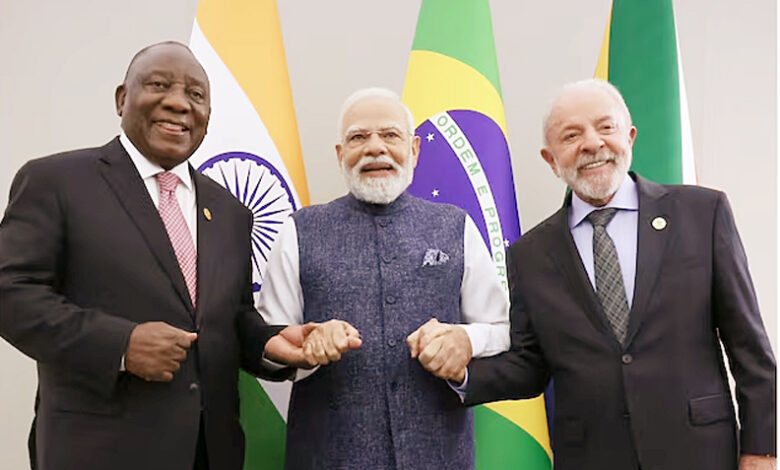
New Delhi — The recently concluded G-20 Summit in Johannesburg has been widely hailed as a historic milestone, marking the rise of a more balanced, inclusive and multipolar global order. Held for the first time on African soil, the summit reflected the growing influence of the Global South, with India playing a pivotal role as a consensus-builder and visionary leader.
Prime Minister Narendra Modi steered the discussions toward pressing global challenges including climate finance, technological transformation, debt crises, and institutional reforms, reinforcing the principle that development must be a shared global responsibility.
Global South Takes Center Stage
Despite the absence of several Western leaders, the summit succeeded in delivering a strong and unified joint declaration, demonstrating the increasing decisiveness of emerging economies. India’s diplomatic outreach and South Africa’s leadership ensured constructive dialogue, signalling that global decision-making is no longer confined to a few traditional powers.
Africa’s Growing Prominence and India–Africa Partnership
The summit placed Africa’s developmental needs firmly on the global agenda. India reiterated that global stability is impossible without acknowledging Africa’s aspirations. New Delhi’s push for African Union’s G-20 membership, approved last year, was highlighted as a transformative step strengthening India–Africa ties.
Debt Crisis: A Call for Fair Solutions
With many developing nations facing severe debt burdens, members agreed on the need for transparent and sustainable debt restructuring. India emphasised that long-term solutions must focus on capacity building, governance, and self-reliance, drawing from its own development journey.
Climate Justice and Energy Transition
Climate change remained a central theme. India strongly advocated climate justice, urging developed nations to honour their commitments on climate finance and technology transfer. India’s proposals on solar energy expansion, circular economy, and sustainable lifestyles were widely acknowledged.

Digital Transformation: India’s Governance Model Shines
The Indian model of Digital Public Infrastructure (DPI) — from Aadhaar and UPI to CoWIN — gained global attention as a scalable blueprint for inclusive digital growth. PM Modi stressed that digitalisation must reduce inequalities rather than deepen them.
Focus on Food Security, Energy Stability and Global Health
India highlighted its contributions to global food supply during crises and underscored the need for diversified energy pathways. On global health, India reiterated the importance of accessible vaccines and resilient healthcare systems, building on its widely recognised pandemic-era initiatives.
India’s Expanding Strategic Influence
Amid geopolitical rivalries and economic uncertainties, the Johannesburg summit reinforced the world’s shift toward cooperation over confrontation. India emerged as a credible, stabilising force capable of bridging divides and facilitating consensus — exemplified by the unanimous adoption of the summit declaration.
Towards a Collective Global Future
As global challenges become more interconnected, India reiterated that sustainable progress depends on mutual respect, shared opportunity and equitable growth. The philosophy of Vasudhaiva Kutumbakam — the world is one family — shaped India’s message that global advancement must be inclusive and collaborative.
The summit made it clear that the world is moving from dominance to partnership, and India stands at the heart of this transformation. With its diplomatic maturity, balanced approach and commitment to an equitable world order, India is no longer just a participant in global discourse — it is now helping shape the global future.